ThemesPerspectives · Adaptation/Mutation · New Frontiers
in:Expeditions designs and leads the learning expedition. Accommodation and transport are booked separately, in your name or through a registered travel operator.
This learning expedition is tailor-made for your group: length, encounters and pace.
Request a programme
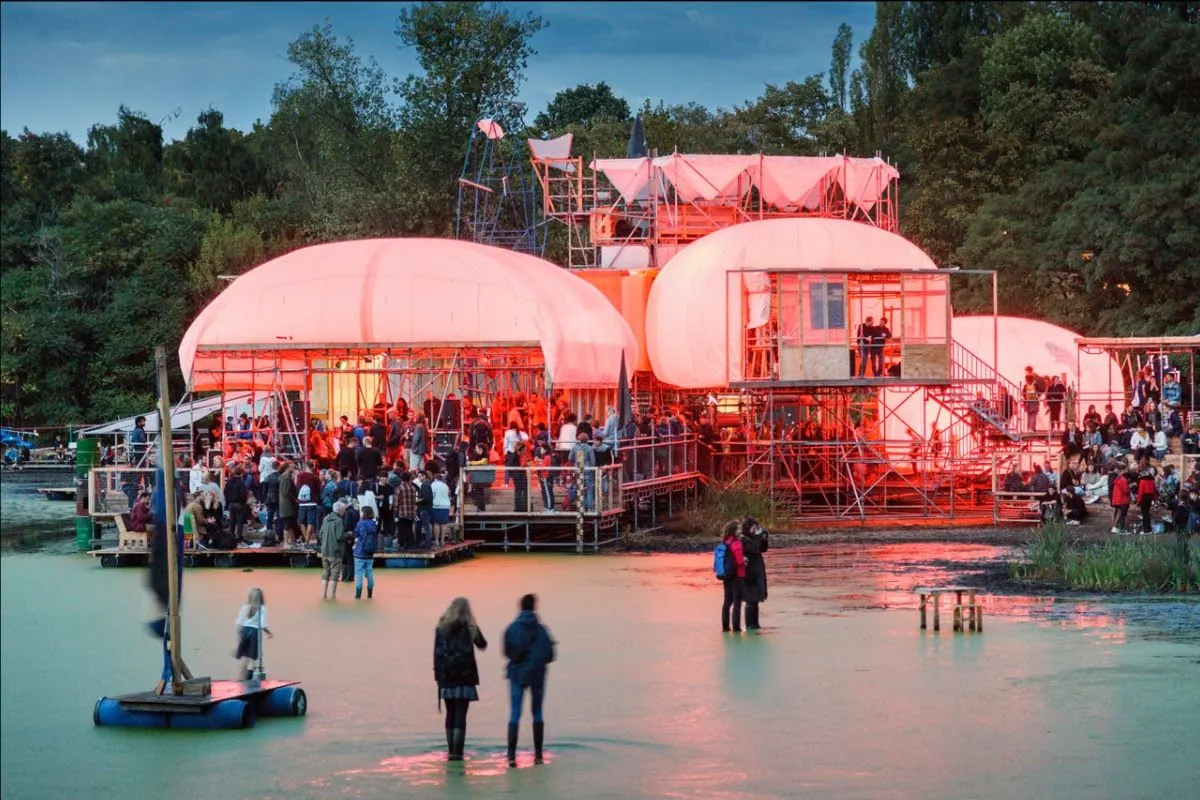
At Tempelhof, the former airport, a stormwater basin built in 1938 still collects the rain. Since 2018 a non-profit has run the Floating University there, an open-air school on climate and the water cycle. At Studio Olafur Eliasson, a team of craftspeople and researchers produces the artist’s work. The group looks back at The Impossible Project, which bought the machines from Polaroid’s last film factory in 2008 and brought instant film back. Leadership teams ask what to do with an asset the market has written off.
Near Alexanderplatz, the headquarters of East Germany’s central statistics administration, empty since 2008, was due to be demolished. In 2015 artists hung a banner on its façade mimicking a construction sign; the State of Berlin bought the complex in 2017. Four public bodies and a citizens’ cooperative now redevelop it as equal partners: on 8 May 2026, more than 50 organisations received the keys to tower A.

At the former Tempelhof airport, a retention basin built in 1938 still collects rainwater. Since 2018 the Floating University has used it as a place to learn about urban climate and the water cycle, now run by the association Floating e.V. Guided tours can be requested from the association; a letter of intent signed with the Berlin Senate in 2024 plans to turn the basin into an infiltration area.
Opened on 5 September 2019 between the main station and the Reichstag, the Futurium devotes more than 3,000 m² of exhibition space to possible futures for people, nature and technology. The building by Richter Musikowski is roofed almost entirely with solar panels and cooled with rainwater from a cistern. Admission is free; groups register in advance and can book a guided tour.



 Agent A\lex