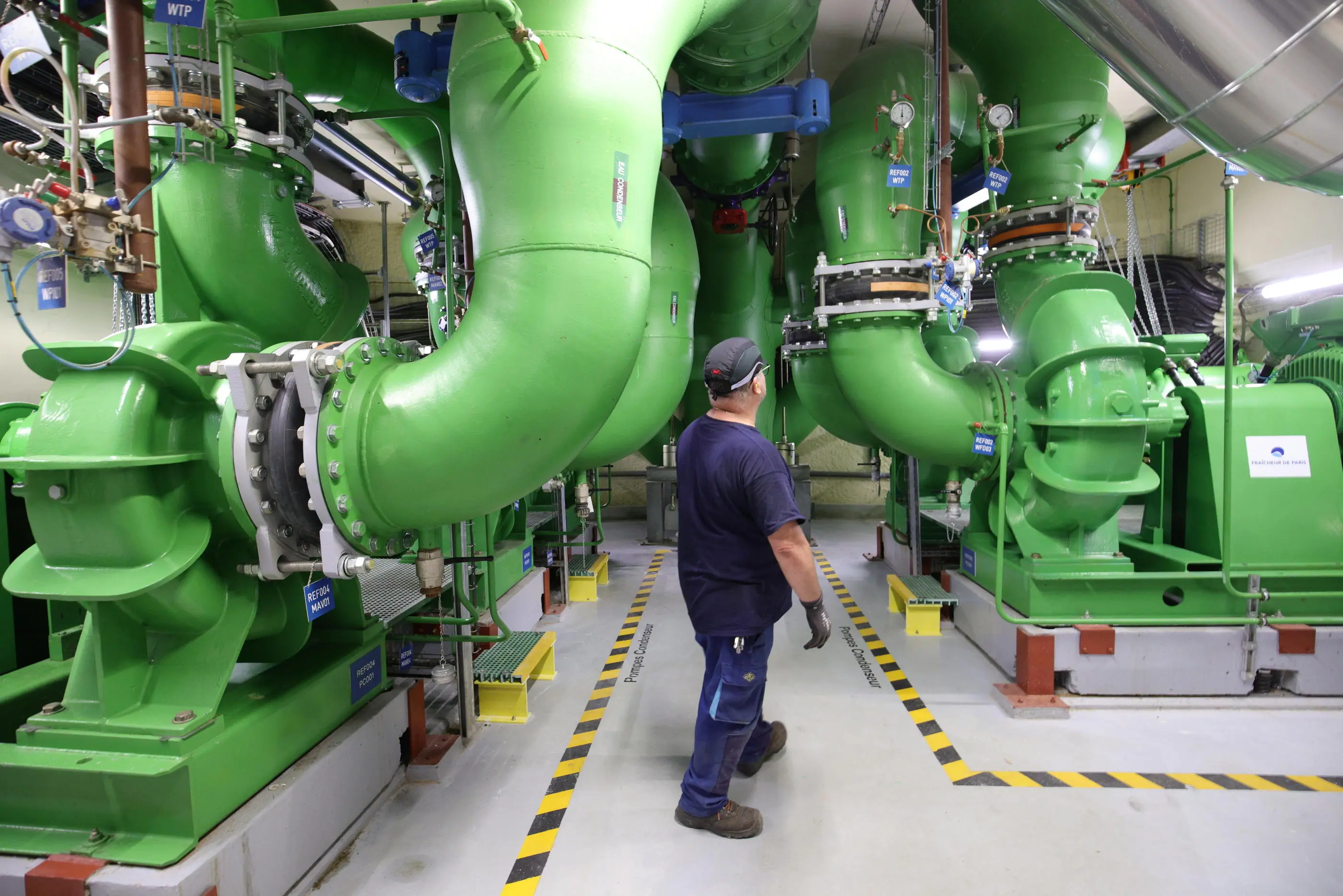
Since April 2022, Fraîcheur de Paris has run the city’s district cooling network, taking over from Climespace. Under the pavements, 120 kilometres of chilled water pipes cool more than 1,000 buildings, from department stores to hospitals.
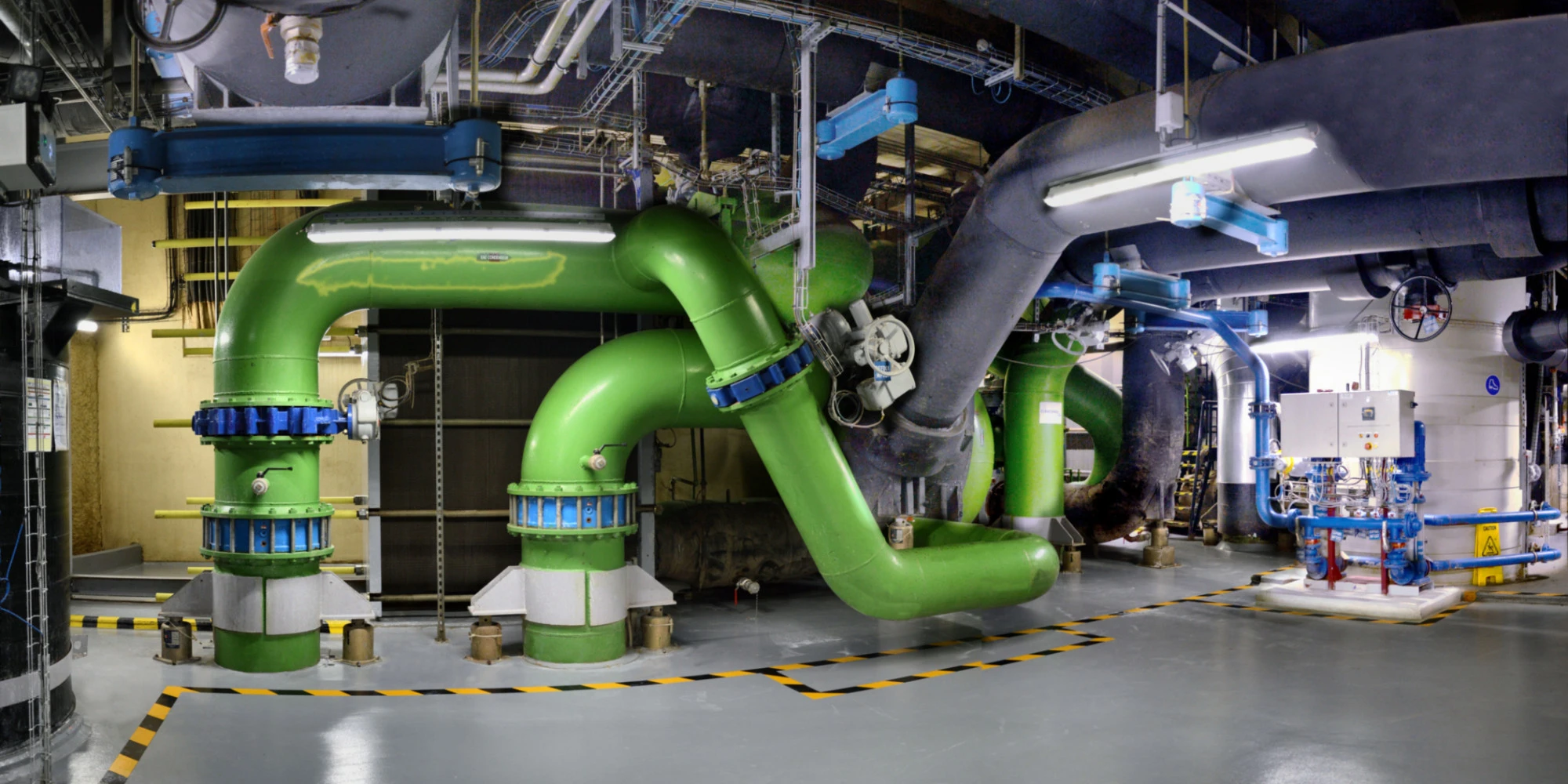
We meet near the Jardin de la Nouvelle France, in the 8th arrondissement, opposite the Pont des Invalides. A retractable spiral staircase rises from the pavement and leads thirty metres down to Canada, one of the network’s fifteen chilled water plants, opened in 2008. Seine water is filtered here, then carries away the heat the network has drawn from connected buildings before returning to the river; the operator says this discharge has no impact on biodiversity.
The City of Paris handed its cooling network to Climespace, an ENGIE subsidiary, in 1991 for thirty years. Since April 2022 the concession has passed for twenty years to Fraîcheur de Paris, owned 85% by ENGIE and 15% by RATP Solutions Ville, which produces, stores, transports and distributes the cold. The network now has fifteen production sites and four storage sites, serving more than 1,000 buildings, or eight million square metres. “It is a gigantic air conditioning network, invisible from the surface, running under the Paris subsoil,” says Catherine MacGregor, CEO of ENGIE.

The network is part of the City’s carbon neutrality target for 2050. Its electricity is 100% renewable and produced in France, nearly 70% of it by four dedicated solar farms. According to the operator, shared production is about 50% more energy efficient than individual air conditioning, with better water management and a more resilient service. Planting at production sites, and along streets during major works, is meant to add another form of cooling.
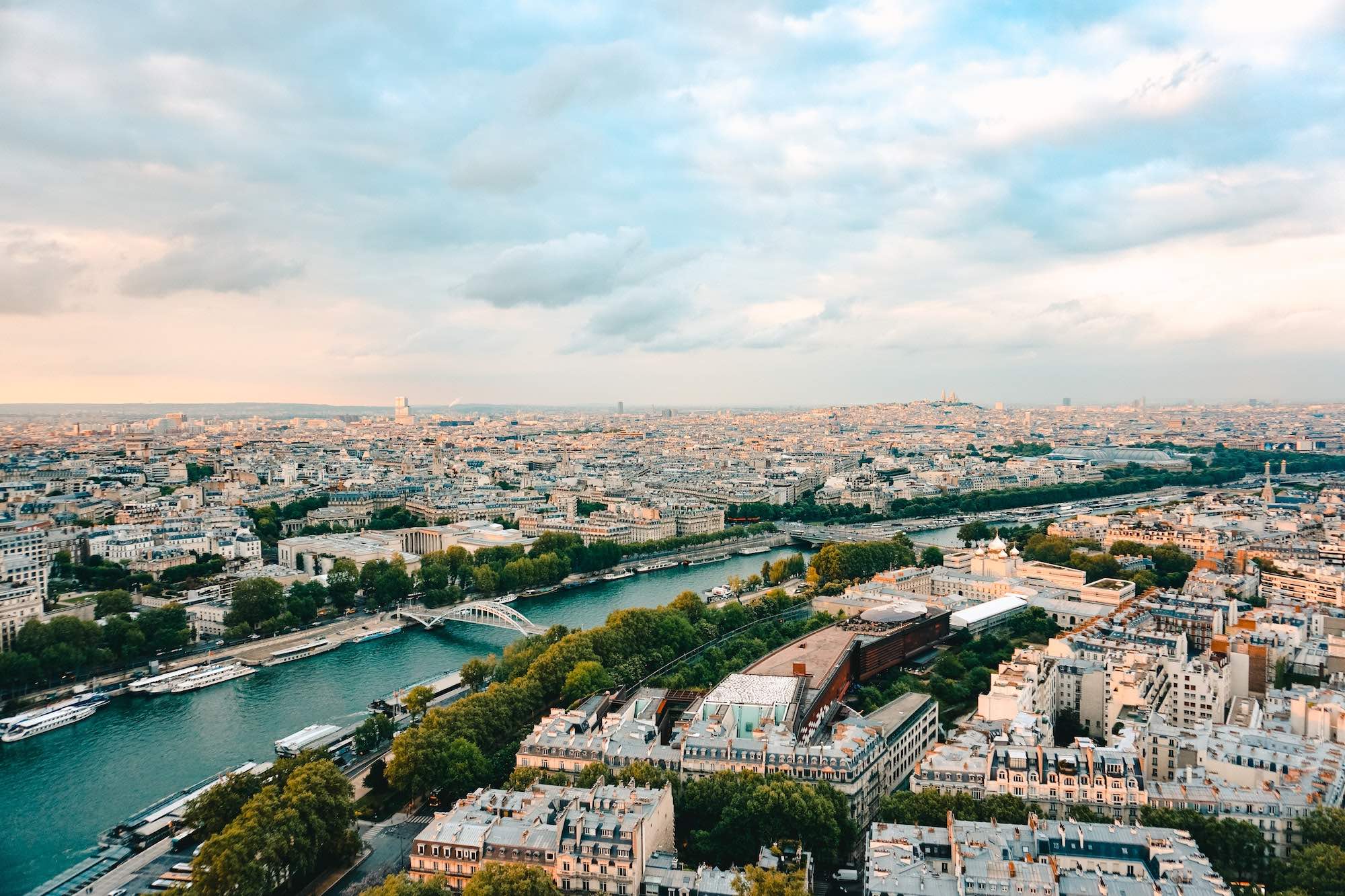
The network also runs in winter, because demand for cooling never stops: data centres, buildings open to the public, industrial processes. When the Seine is cold enough, it chills the network water directly through heat exchangers, without the two circuits mixing. The chillers and circulation pumps of the plants then shut down. This free cooling sharply cuts electricity use in the cold season.
By 2042, Fraîcheur de Paris aims to cover every arrondissement and build “the world’s largest cooling network”. Its targets are busy public places: tourist sites, department stores, museums, offices, small shops and town halls, and, as a public service, hospitals, nurseries, schools and care homes. Connecting private buildings is under study. The operator compares its network to public transport: a shared solution that curbs the spread of standalone air conditioners and makes the city more resilient to heatwaves.
The 2022-2042 concession plans to triple the network’s length, installed capacity and number of subscribers: 250 kilometres of pipes in the end, one new production plant every year and 3,000 connected buildings. Fraîcheur de Paris estimates 300,000 tonnes of CO2 emissions avoided over the life of the concession. These are the operator’s targets, provided by Fraîcheur de Paris in November 2026.
Would you like to meet these people with your team? in:Expeditions designs tailor-made learning expeditions around places like this one.
 Or design it yourself with Agent A\lex →What is a learning expedition? →